|
Jan 23
MegaMold is a 100% pure silicone RTV mold material that picks up the finest detail possible. Almost anything can be molded using MegaMold. Capture the most detailed textures and elements with MegaMold and find out why it’s the most loved mold material. Watch and see how Mardel makes molds of very delicate corals. Check out all our free Tool Demo videos in our Video Library. Jan 23 Introducing the new 16 oz MegaMold kit, a Mega size that is 4 times larger than the original. MegaMold is the most-loved pure silicone RTV molding material and now it is on sale!
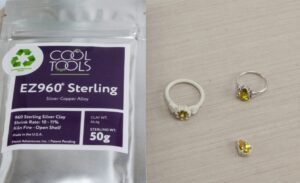
Order our 4 oz kit OR our 16 oz kit of MegaMold today and receive 10% off. Use code “MEGA” at checkout. Hurry sale ends 1/29/12 at 11:59 pm CST. Dec 15 Dec 12 Even though I’ve pioneered co-firing diamonds in metal clay, I was not sure my big diamond would succeed because it was not the best quality stone.
Diamonds are harder than any other gemstone* and only a diamond can scratch a diamond, but firing tests that were done years ago revealed that they have a habit of vaporizing or crazing when heated in a kiln. That may seem odd, but as a classically trained jeweler I know that diamonds can be heated directly with a torch for a few seconds without damaging them. What they can’t take is a long heating. So to me, putting a diamond in the kiln for the 30-minute burnout cycle would be insane. In order to fire the diamond safely, I had to skip the burn-out firing, which I don’t think is necessary anyway. I ignited the greenware with a flame, allowed it to burn away, cooled it, and then fired in activated carbon for 2 hours. The stone was totally undamaged, but it shifted in the setting during firing and is a little cattywompus, which is no big deal for me to fix. What I was concerned with was if a low quality stone would survive. And the answer is yes. My stone was unharmed. Tips for Strong Jewelry in PMC STERLING One of the things I’ve learned about PMC STERLING is the same thing I know about all the other types of metal clay, the longer it’s fired, the more dense and the stronger it is. For items where strength is not an issue, fire for the least amount of time. 1 hour is sufficient for most earrings and necklaces. For rings, bracelets and delicate items (things with fine parts and tendrils), fire for 2 hours and you’ll have amazingly strong jewelry….just like cast sterling. Even in an unfired greenware state, PMC STERLING is super strong. To make the prongs for the diamond ring I cut out a tiny ring of clay, cut the ring in quarters and let it dry. To place the prongs, I picked each one up with diamond tweezers and dipped one end in water and then held it in place for a few seconds on the ring. I guess I held one prong too tight and it broke in half. I was in a time crunch so I just put a tiny bit of water on the pieces and held those together. I can’t tell which prong I repaired, and I’ve hammered on all of them. What is important when firing PMC STERLING is using a reliable kiln with a temperature that can be held accurately for the duration. PMC STERLING is sintered at a temperature that is just a few degrees away from its melting point. If you try to use a tiny kiln that does not have a digital controller, you cannot be sure that your work is properly sintered or melt your work by going over temperature. The Ultra-Lite Beehive kiln, the Amaco Trinkit kiln and other tiny kilns with pyrometers for temperature control are not appropriate for PMC STERLING firing. You must be able to accurately gauge the temperature for the duration of the firing. Recommended kilns: Any of the kilns we offer with a digital controller are perfect for PMC STERLING firing such as the Paragon SC series, Caldera, Digital Firefly, Home Artist and E Series kilns. The Evenheat Kingpin 88 series and Olympic Jewelry Artist are also great choices. You’ll also need a firing vessel and activated carbon to contain your work during firing. Click here to learn more about kilns. *Diamonds are no longer the hardest substance known to man. There are man-made nanoparticles that are harder than diamonds, but some years ago 2 substances, wurtzite boron nitride and the mineral londaleite were discovered that can handle 18% and 58% more stress respectively than a diamond. -Mardel Dec 2
Check out our new videos with some great Gilders Paste techniques!
Patterned Brass Earrings Project Make these beautiful & intricate brass earrings. Use Gilders Paste to highlight filigree and finely detailed designs.
Keep an eye out for more Gilders Paste Videos with great new techniques! Check out our always-growing Video Library including our Product & Tool Demos section for even more great videos on all the tools and supplies you love. Nov 30
According to the insert for PMC STERLING, a double firing is required to transform it from powdered to solid metal. The first firing is supposed to be on an open kiln shelf for 30 minutes at 1000F and then another 30 minute firing at 1500F buried in carbon. Since I’m lazy and since the open air firing sounded too slow, I decided to speed it up. Skip the First Firing I found that I can ignite the binder with a torch and skip the entire first firing, saving both time and energy. Here’s how I do it: Turn the lights down. Make a soft, bushy flame with the torch and light the greenware on fire. Watch as the flame eats through the whole piece. If you can’t tell if it’s all burned out, light it again. Then cool and embed in coconut carbon and fire at 1500F for at least 30 minutes. Here are some more tips for working with PMC STERLING. Co-Firing Findings & Settings Any item of sterling silver, as long as it does not contain solder can be embedded and fired in place. If something has solder, it could fall apart or be seriously weakened during firing. Wire, laser-welded and die-struck settings can safely be fired in place. I highly recommend torch burnout if you plan to co-fire sterling silver parts to avoid heating copper in the open air. When copper is heated above 1200F for more than 30 minutes, it becomes incredibly brittle. Heating to 1000F is going to cause deep fire scale that can be avoided by not heating unprotected for so long. And though it might not be 1200F, it’s still going to weaken the metal, and that’s unacceptable for jewelry. Carbon firing, on the other hand, protects sterling silver from the combined damage of heat and oxygen. Using Paste as Solder
Whatever paste you don’t use, spread it thin so it’s easy to rehydrate. To rehydrate, add water a bit at a time until you reach the desired consistency. It rehydrates beautifully over and over again. Co-Firing Gemstones Use my Gemstones in Metal Clay guide to find which stones are safe in carbon. If they are safe in carbon, they are most likely safe for torch burnout because the temperature is so low and it’s so quick. What damages stones is the oxygen and heat combination for long periods of time.
You’ll have to set glass after firing since it can’t handle a carbon firing. Firing Time 30 minutes is the minimum firing time for PMC STERLING. Firing time can be extended for extra strength. Pieces that were pasted on low dome wire and fired only 30 minutes broke off when I formed it on a mandrel. After re-pasting and re-firing for 2 hours, the pieces were as good as soldered on. Soldering PMC STERLING is no different to solder than any other sterling silver. Use the type of solder that you are comfortable working with. Pickle and polish like any other sterling silver. How Far Does it Go? This photo represents everything I’ve made so far with one 25 gram package, and I still have some left. What you see in the photo is as follows, from left to right:
…and I still have about 5 more grams plus a bunch of dust and paste. That’s a nice pile of jewelry out of one package of clay. It’s going a lot further because I know it’s strong so I can make pieces more delicate and thinner, and that saves a lot of material. Stay tuned for the results of the big diamond ring firing experiment! -Mardel Nov 23 PMC STERLING is finally here, and I love it! I’ve had a chance to play with the clay a bit and I’m so excited about it! Here is a summary of what I’ve noticed so far in working with PMC STERLING – Sterling Silver Jewelry Clay: Right out of the package, PMC STERLING feels like it’s been conditioned with something to make it anti-stick because it doesn’t seem to want to stick to my fingers the way other forms of silver clay do. It’s not as squishy as PMC3 and it seems to have some rebound when I impress it. When I roll it into a ball, the clay feels almost rubbery. I can roll out fine tendrils and form curves and coils without having to add water and without the clay cracking. (Awesome!) Wet parts have more body than the other formulas, and the clay seems to have more integrity and more strength in it’s moist state. It’s also really nice to handle. I can even move small parts around with tweezers that I’ve just formed. There was one surprise with PMC STERLING. It sticks like mad to textures. I made a couple of videos showing my first experiences with PMC STERLING so you can see what happened and how I dealt with it. Here are links to the videos: PMC STERLING -Working With PMC Sterling Clay, and Storing PMC Sterling Clay. I’ll be adding more videos as I get them done to cover firing, finishing, soldering, stone setting and other things you can do with PMC STERLING. Our first shipment of PMC STERLING is on the way to us and it’s available right now for pre-order in our store. Pre-orders will have shipping priority when our stock arrives, so order now and be the first to work with this amazing clay. Have a wonderful holiday and thank you for supporting what we do here at Cool Tools! -Mardel Nov 8 Congratulations to Valerie Valenzuela, the Random Review Winner for October! She has won a $100 Cool Tools gift certificate simply for offering us her thoughts on a product she purchased. Valerie reviewed one of our Design Stamps and gave them a 5-Star rating calling them “effective & versatile”. Valerie was very excited and told us a little about herself:
Keep reviewing products and offering us your thoughts. Your comments and reviews help other jewelry artists get a better idea of the products! Help us congratulate Valerie this month! Nov 4 What does bread and a leather sandbag have in common? They both need to be kneaded! Use the sandbagto deaden sound and absorb shock, and to cushion items such as when engraving, carving, and texturing metal, and to raise work off the surface of the bench. Do not use with metal stamping tools. Always work directly on a steel bench block which is set on a firm surface for stamping. Keep an eye out for more Tool Demo videos in our Video Library! Nov 4 This Bench Block is a hard rubber dapping block with 6 working surfaces which offer ideal resilience when working with steel and hardwood punches, perfect for filing and other detail work. Use below a bench block to absorb shock and deaden sound. Use as a platform for sanding, filing, finishing and even assembling metal clay works. Makes a perfect platform for bezel setting because the rubber grips the piece and helps hold it in place. Check out all our videos in our Video Library today! |